Developer Documentation: StopThiefDataTest
Overview
Stop Thief! is an out-of-print board game by Parker Brothers released in the late 1970s. The game relies on a hand-held electronic device (see Fig. 1) that acts as the thief, using sounds and numbers corresponding to board spaces to give clues to players as to where the thief is on the board (see Fig. 2). Players use these clues to track the thief, and use their corresponding token and dice to advance to the perceived thief location to "arrest" the thief. If the electronic hand-held "Electronic Crime Scanner" breaks, the game is effectively unplayable. This iOS app simulates the logic of the Crime Scanner and modernizes it for today's mobile Apple devices.
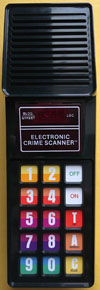
Fig. 1. Electronic Crime Scanner
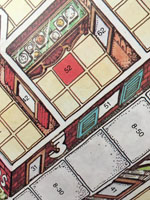
Fig. 2. Part of gameboard showing Antiques building (building 3) and the street; the thief can be on any numbered board space; potential crime scenes are red board spaces
The StopThiefDataTest is a proof of concept Swift/Xcode project that hosts and validates the thief logic for the app.
Source code can be found on Github
Classes, Structures and Enums Overview
 BuildingStreet
The game utilizes a three-digit number to indicate a potential location of the thief. The first of the three numbers represents the building or street, with the final two representing the board space within that building or street (see Fig. 2 above).
This enumeration lists the buildings and streets and assigns them the corresponding number.
enum BuildingStreet: Int {
    case furs = 1
    case jewelry = 2
    case antiques = 3
    case bank = 4
    case fifthStreet = 5
    case sixthStreet = 6
    case seventhStreet = 7
    case eighthStreet = 8
}
Enumeration representing the type of board space; the thief can start or move to a board space visually represented by one of the following:
crime: the thief starts the game on a crime space and can move to other crime spaces on the board to commit further crimes during the game; there are a limited number of crime board spaces on the game board so these can really help players determine where the thief might be.
floor: a board space in a room of a building
door: the thief can open a door and stand on that space before advancing through it; the thief can enter or exit a building through a door
window: the thief can break a window and climb into it before advancing through it; the thief can enter or exit a building through a window
street: a board space on a street adjacent to a building
subway: the thief can move to a subway board space and travel to any other subway board space on the game board.
donothing: the app can randomly choose for the thief to stay on their current board space; while not a physical location type, this still must be tracked in the thief's move history
enum LocationType:String {
    case crime
    case floor
    case door
    case window
    case street
    case subway
    case donothing
}
When the user starts the game, the app initializes the game board as an array in memory, each numbered board space represented by a Location structure. The app also keeps track of the thief's movements with an array containing copies of the Location structure
Variables:- locationNumber stores the full three-digit game board space
- buildingStreet stores the enumeration that represents the first number in the three-digit board game; this represents the building or street
- locationType stores the enumeration that represents the visual appearance of the board space (is it a window, a door, etc.)
- adjacentLocations stores an array of three-digit numbers representing the board spaces adjacent to the current location; rules indicate the thief cannot move to a previous board space and additionally must move through a door or window to the other side once opened or broken
var locationNumber: Int
var buildingStreet: BuildingStreet
var locationType: LocationType // if LocationType.crime, and a crime occurs here, change to floor/street
var adjacentLocations: [Int] //stores array of numbers representing board spaces
Initialize locationNumber, buildingStreet, locationType and adjacentLocations with corresponding values passed to the constructor.
init(locationNumber: Int, buildingStreet:BuildingStreet, locationType:LocationType, adjacentLocations: [Int]){
        self.locationNumber = locationNumber
        self.buildingStreet = buildingStreet
        self.locationType = locationType
        self.adjacentLocations = adjacentLocations
    }
changeLocationType
If the board space locationType is crime, the app calls this function to change its type to just a regular floor or street space. The game rules indicate that once the thief commits a crime at that board space, they cannot return to that space to commit another crime (the jewels, money, etc., have been stolen and cleared out previously), so if the thief moves to that board space again, it is treated as a regular building or street space.
   mutating func changeLocationType(){
        if buildingStreet == BuildingStreet.seventhStreet{
            locationType = LocationType.street
        }
        else{
            locationType = LocationType.floor
        }
    }
When the thief moves to a door or window board space, they must move through it on the next turn, barring staying in that board space. Board spaces on opposite sides of doors and windows are numbered such that board spaces on one side are always greater than or less the board spaces on the other. The GameState class uses this enumeration when determining in which direction the thief must move.
enum GreaterOrLessThan:Int{
    case greaterThan
    case lessThan
}
This class sets up and stores the initial state of the game board and drives gameplay in advancing the thief between board spaces.
Variables and Constants:- MAX_NUM_CRIMESCENES there are 19 crime board spaces on the game board; the app uses this constant when the game begins to determine upon which board space to start the thief
- PERCENT_CHANCE_THIEF_DOES_NOT_MOVE the game logic has to take into account that the thief may elect to not move on their turn; initially there is a 10% chance the thief stays put
- gameBoard this single dimensional array stores the Location objects of the current game; the app initializes gameBoard when a player elects to begin a game
- crimeScenes this array stores the three-digit numbers for the 19 crime board spaces on the game board; the app uses this array to randomly start the thief on a board space when the game begins
- currentLocation this variable holds the three-digit number of the board space where the thief resides
- previousLocation this variable holds the three-digit number of the board space where the thief resided on their previous turn; the thief cannot move to a previousLocation from their currentLocation, so the app uses this variable to ensure this doesn't occur
    let MAX_NUM_CRIMESCENES = 19
    let PERCENT_CHANCE_THIEF_DOES_NOT_MOVE = 10
    var gameBoard: [Int: Location] = [:] //stores Location spaces where thief might be
    let crimeScenes = [123,144,146,164,242,245,247,265,267,337,352,355,376,425,445,463,465,467,709]
    var currentLocation = 0
    var previousLocation = 0
The constructor calls createGameboard in preparation to start gameplay.
init(){
        createGameboard()
    }
createGameboard
Called by the constructor. createGameboard aggregates calls to functions that add all the numbered board spaces to the gameBoard array, representing the spaces where the thief can move.
This function initially calls the function insertLocation inserting a location number of 0, which represents when the thief does not move on their turn. In another class, the app uses an array to keep track of the board spaces that represent each turn the thief takes. On turns when the thief does not move, the app still needs to store something in this array to represent their turn. In these cases, the app stores a copy of Location with location number 0. Subsequently, createGameboard calls addFurriers, addJewelers, addAntiques, addBank, addFifthStreet, addSixthStreet, addSeventhStreet and addEighthStreet to populate the Location array.
    func createGameboard(){
        //insert a "do nothing" location at index 0
        //this occurs when 10% of the time the thief does not move;
        //this "action" is still recorded in the thief's move history so needs a location
        //corresponding to a sound
         insertLocation(locationNumber: 0, buildingStreet: BuildingStreet.furs, locationType: LocationType.donothing, adjacentLocations: [])
        //add all the remaining game board locations
        addFurriers()
        addJewelers()
        addAntiques()
        addBank()
        addFifthStreet()
        addSixthStreet()
        addSeventhStreet()
        addEighthStreet()
    }
addFurriers, addJewelers, addAntiques, addBank, addFifthStreet, addSixthStreet, addSeventhStreet, addEighthStreet
Each of these functions repeatedly calls insertLocation passing the board space number, the corresponding building/street, board space type, and an array of the adjacent board spaces that the thief could move to on their next turn.
insertLocation
This function adds a Location object into the gameBoard array at an index corresponding to the board space three-digit number, and populates that Location with its corresponding building/street, the board space type (subway, building, etc.), and an array of the adjacent board spaces that the thief could move on their next turn.
    func insertLocation(locationNumber:Int, buildingStreet:BuildingStreet, locationType:LocationType, adjacentLocations:[Int]){
        gameBoard[locationNumber] = Location(locationNumber: locationNumber, buildingStreet: buildingStreet, locationType: locationType, adjacentLocations: adjacentLocations)
    }
getFirstClue
This function returns a three-digit number representing the starting board space of the thief. The function determines this by randomly choosing a number from the crimeScenes array.
    func getFirstClue() -> Int{
      currentLocation = crimeScenes[getRandomNumber(max: MAX_NUM_CRIMESCENES)]
        return currentLocation
    }
getClue
This function returns a three-digit number representing the new location of the thief. The function first does a random number check to see if the thief is skipping their turn and standing still, in which getClue returns case board space location number 0. getClue then determines if the thief's current board space is a crime, and if so, calls changeLocationType to change the location type of the current Location array board space to a regular street or building floor board space as the thief cannot steal from a crime square they've already been to. getClue then calls getNextLocation to retrieve a new board space location where the thief will move. getClue then assigns the current Location to the previous Location, and sets the new board space Location number to the currentLocation and returns that.
    func getClue()->Int{
        var nextLocation = 0
        //check to see if thief does nothing
        if getRandomNumber(max: PERCENT_CHANCE_THIEF_DOES_NOT_MOVE) == 0{
            return 0
        }
        if gameBoard[currentLocation]?.locationType==LocationType.crime{
            gameBoard[currentLocation]?.changeLocationType()
        }
        nextLocation=getNextLocation()
        previousLocation = currentLocation
        currentLocation=nextLocation
        return currentLocation
    }
getNextLocation
getClue calls this function to perform extensive checks on the adjacent locations of the thief to determine the their next move. getNextLocation gets a copy of the array of adjacentLocations to the current Location; these represent all the possible board spaces to where the thief can move on this turn.
getNextLocation then removes the previousLocation from the adjacentLocations array as this is an invalid move.
getNextLocation then determines if the current location is a window or door. If so, the thief must continue through it to the other side, so getNextLocation calls getLocationsOnOtherSideOfDoorWindow which will return a subset of the adjacent Locations array from which to randomly choose a new board space.
getNextLocation then determines if the current location is a subway. If so, it calls dealWithSubwayTravel to get a subset of the adjacentLocations array from which to randomly choose a new board space.
getNextLocation then determines if any of the board spaces in the adjacent Locations array is a crime type by calling lookForAdjacentCrimeLocations which will return a corresponding array.
getNextLocation then calls getRandomNumber on the adjacentLocations array to get and return the next random Location board space to which the thief will move.
    func getNextLocation() -> Int
        //get list of adjacent locations
        var adjacentLocations = gameBoard[currentLocation]?.adjacentLocations
        //thief cannot return to location she/he was just at so remove from list
        adjacentLocations?.remove(at: getIndexOfMatchingValue(adjacents: adjacentLocations!,lookingFor:previousLocation))
        //is the current location a door or window; if so thief HAS TO go through it
        if gameBoard[currentLocation]?.locationType==LocationType.door || gameBoard[currentLocation]?.locationType==LocationType.window{
     adjacentLocations=getLocationsOnOtherSideOfDoorWindow(adjacents: adjacentLocations!)
        }
        //is the current location a subway
        if gameBoard[currentLocation]?.locationType==LocationType.subway{
            adjacentLocations=dealWithSubwayTravel(adjacents: adjacentLocations!)
        }
        //if any of the remaining adjacent locations is a crime location thief must go there
        let crimeLocations: [Int] = lookForAdjacentCrimeLocations(adjacents: adjacentLocations!)
        if crimeLocations.count != 0{
            adjacentLocations = crimeLocations
        }
        //randomly choose a location number from the array and return it
        return adjacentLocations![getRandomNumber(max: (adjacentLocations?.count)!)]
    }
resetTheCrimeScenes
Once a thief leaves a building, all the valuables at each crime board space are replenished and floor locations return to being crime locations if they were robbed and then changed.
resetTheCrimeScenes first determines the building number of the current board space Location.
resetTheCrimeScenes then creates an array of the crime board space Locations in that building.
resetTheCrimeScenes then loops through that array using the number to index the gameBoard array and resetting the locationType of that Location to that of crime.
    func resetTheCrimeScenes(){
        //get the building number
        let buildingNumber = currentLocation/100
        var crimeLocations:[Int] = []
        //for that building, get the list of crime locations
        switch buildingNumber {
        case 1:
            crimeLocations=[123,144,146,164]
        case 2:
            crimeLocations=[242,245,247,265,267]
        case 3:
            crimeLocations=[337,352,355,376]
        default:
            crimeLocations=[425,445,463,465,467]
        }
        //loop through crime locations and ensure they are crime
        for index in 0 ... crimeLocations.count-1{
            let locationNumber = crimeLocations[index]
            gameBoard[locationNumber]?.locationType = LocationType.crime
        }
    }
lookForAdjacentCrimeLocations
This function creates and returns an array of the three-digit Location board spaces whose location type is crime.
    func lookForAdjacentCrimeLocations(adjacents: [Int])->[Int]{
        var crimeLocations: [Int] = []

        for index in 0 ... adjacents.count-1{
            let locationNumber = adjacents[index]

            let location = gameBoard[locationNumber]
            if location != nil{
                if location?.locationType==LocationType.crime{
                    crimeLocations.append(adjacents[index])
                }
            }
        }
        return crimeLocations
    }
dealWithSubwayTravel
If the previousLocation type was a subway, the thief cannot take that subway again. dealWithSubwayTravel determines if the prevousLocation type is subway, and if so calls getNonSubwayLocations to get a subset of the adjacentLocations that are not subway board space Locations.
If the currentLocation is a corner subway (there are four corner subway stations and one in the centre of the game board) the thief must take the subway to another subway station. This function gets a subset of just the five subway stations.
The function returns the subset of adjacent Locations.
    func dealWithSubwayTravel(adjacents:[Int])->[Int]{
        var tempAdjacents = adjacents
        //if previousLocation was a subway, thief already travelled so can't immediately travel again
        if gameBoard[previousLocation]?.locationType==LocationType.subway{
            tempAdjacents = getNonSubwayLocations(adjacents: tempAdjacents)
        }
        else{
            //if the currentLocation is a corner subway, thief must take subway
            if currentLocation==599 || currentLocation==699 || currentLocation==799 || currentLocation==899{
                tempAdjacents = [500,599,699,799,899]
            }
        }
        return tempAdjacents
    }
getLocationsOnOtherSideOfDoorWindow
If a thief opens a door or breaks a window, they have to go through it. Board space locations greater than 499 are on the street, while those below are in buildings. In addition, all locations in a building on one side of a door are either greater than or less than those on the opposite side. Thus by comparing the previousLocation to the currentLocation (the door/window) this function can determine in which direction the thief must move.
If the previous location was on the street, the function calls getIndexOfGreaterOrLesserValue passing lessThan to get all the locations in the adjacentLocations that are in the building.
Otherwise, the function calls getIndexOfGreaterOrLesserValue passing greaterThan to get all the adjacentLocations that are on the street. Here, also, the function calls resetTheCrimeScenes as the thief is leaving the building so all the valuables will be refreshed and the thief can reenter the building later in the game to steal again.
Buildings have internal doors and windows between rooms. If by now the temporary array has no values in it, the door/window was internal to a building, so the function just calls getIndexOfGreaterOrLesserValue to get the array of board space Locations on the opposite side of the window or door.
The function then returns the temporary array of adjacent Locations.
    func getLocationsOnOtherSideOfDoorWindow(adjacents:[Int])->[Int]{
        var tempAdjacents = adjacents
        //if the previousLocation is greater than 499, thief was on the street and is entering the building
        if previousLocation>499 {
            tempAdjacents = getIndexOfGreaterOrLesserValue(adjacents: tempAdjacents, lookingFor: 499, greaterOrLessThan: GreaterOrLessThan.lessThan)
        }
        else{
            //go through adjacents list and get anything > 499; this indicates an outside door/window
            tempAdjacents = getIndexOfGreaterOrLesserValue(adjacents: tempAdjacents, lookingFor: 499, greaterOrLessThan: GreaterOrLessThan.greaterThan)
            //if there are items in list, thief was leaving building so reset the crime locations
            if tempAdjacents.count != 0{
                resetTheCrimeScenes()
            }
        }
        //check if door/window is inside a building; if tempAdjacents has no items, the door/window is inside
        if tempAdjacents.count == 0{
            tempAdjacents=adjacents //reset working list of adjacent locations
            if previousLocation > currentLocation{
                    tempAdjacents = getIndexOfGreaterOrLesserValue(adjacents: tempAdjacents, lookingFor: currentLocation, greaterOrLessThan: GreaterOrLessThan.lessThan)            }
            else{
                    tempAdjacents = getIndexOfGreaterOrLesserValue(adjacents: tempAdjacents, lookingFor: currentLocation, greaterOrLessThan: GreaterOrLessThan.greaterThan)            }
        }
        return tempAdjacents
    }
getIndexOfMatchingValue
This function loops through a list of adjacent Locations for a given value and returns the array index.
    func getIndexOfMatchingValue(adjacents:[Int],lookingFor:Int)->Int{
        for index in 0 ... adjacents.count-1{
            if lookingFor == adjacents[index]{
                return index
            }
        }
        return 0
    }
getIndexOfGreaterOrLesserValue
Given an array, this function can return an array subset whose values are greater than or less than a specific value. getLocationsOnOtherSideOfDoorWindow and getNextLocation call this function to get the list of adjacentLocations where the thief can legally move.
    func getIndexOfGreaterOrLesserValue(adjacents:[Int],lookingFor:Int,greaterOrLessThan:GreaterOrLessThan)->[Int]{
        var tempAdjacents:[Int] = []

        if greaterOrLessThan==GreaterOrLessThan.greaterThan{
        for index in 0 ... adjacents.count-1{
            if adjacents[index]>lookingFor{
                tempAdjacents.append(adjacents[index])
            }
        }
        }
        else{
            for index in 0 ... adjacents.count-1{
                if adjacents[index]<lookingFor{
                      tempAdjacents.append(adjacents[index])                }
            }
        }
        return tempAdjacents
    }
getNonSubwayLocations
If the thief just took the subway, they have to exit to the street. This function loops through the adjacentLocations and creates a tempArray containing only non-subway board space Locations to return. dealWithSubwayTravel calls this function.
    func getNonSubwayLocations(adjacents:[Int])->[Int]{
        var tempAdjacents:[Int] = []

            for index in 0 ... adjacents.count-1{
                let locationNumber = adjacents[index]

                let location = gameBoard[locationNumber]
                if location != nil{
                if location?.locationType==LocationType.subway{
                    tempAdjacents.append(adjacents[index])
                }
            }
        }
        return tempAdjacents
    }
getRandomNumber
getNextLocation calls this function to randomly generate the index of the thief's next board space Location.
    func getRandomNumber(max: Int) -> Int {
        let randomNum = Int(arc4random_uniform(UInt32(max)))
        return randomNum
    }
This class is the ViewController in Swift's MVC pattern for the app UI. Meant to test the core data classes, ViewController has a clueButton the user can press to generate clues, or the new board space Location of the thief, and a tableView to display all the thief's moves or board space Locations.
Variables:- nib a reference to the NEXT Interface Builder file representing the UI.
- tableView a reference to the UITableView on the UI that is a list of the thief's moves or board space Locations
- clueButton a reference to the button on the UI that the user can press to get the next clue, or next move made by the thief to another board space Location
- firstClue a Boolean indicating if the game is starting and the user is pressing the clueButton for the first time; if so the first clue or board space Location must be a crime board space
- clues an array of Location objects representing the moves or board space Locations the thief has traversed
- gameState an instance variable of the GameState class that contains the core logic to determine the state of the board and how the thief should move
    let nib = UINib(nibName: "ClueTableViewCell", bundle: nil)
    @IBOutlet var tableView: UITableView!
    @IBOutlet var clueButton: UIButton!
    var firstClue = true
    var clues: [Location] = []
    var gameState = GameState()
getClue
This function responds to the user pressing the clueButton.
getClue examines the firstClue Boolean, and if true, calls the GameState getFirstClue function to get a crime game board Location to add to the clues array. getClue then flips the firstClue Boolean and it will remain so for the remainder of the game. If firstClue is false, getClue calls the normal GameState getClue function to get the thief's next board space Location.
getClue calls reloadData on tableView to refresh the view to show the new Location in the list.
    @IBAction func getClue(sender: UIButton){
        if firstClue{
            clues.append(gameState.gameBoard[gameState.getFirstClue()]!)
            firstClue=false
        }
        else{
           clues.append(gameState.gameBoard[gameState.getClue()]!)
}
tableView.reloadData()
}
viewDidLoad
This function registers the ClueTableViewCell, the formatted UI row for the TableView so it can be recycled to display rows as the user scrolls the list. To bind the tableView to the clues array, this function sets the delegate and dataSource which will require tableView constructors in this class.
    override func viewDidLoad() {
        super.viewDidLoad()
  tableView.register(nib, forCellReuseIdentifier: "ClueTableViewCell")
        tableView.delegate = self
        tableView.dataSource = self
    }
didReceiveMemoryWarning
Overridden system function added by Xcode called in the case of memory issues.
    override func didReceiveMemoryWarning() {
        super.didReceiveMemoryWarning()
        // Dispose of any resources that can be recreated.
    }
tableView
Two constructors for the TableView UI control: one constructor returns the number of items in the clues array that is bound to the TableView UI control; and the other constructor removes and returns ClueTableViewCells as they disappear from the TableView as the user scrolls so the UI can reuse them to show the next item in the clue array bound to the TableView.
    func tableView(_ tableView: UITableView, numberOfRowsInSection section: Int) -> Int {
        return clues.count
    }

    func tableView(_ tableView: UITableView, cellForRowAt indexPath: IndexPath) -> UITableViewCell {
        let cell = tableView.dequeueReusableCell(withIdentifier: "ClueTableViewCell", for: indexPath) as! ClueTableViewCell
        cell.locationNumber.text = String(clues[indexPath.row].locationNumber)
        cell.locationType.text = String(describing: clues[indexPath.row].locationType)
        return cell
    }
}